Sunday, 7 August 2011

Deflation Forces, back Again in Finland.

Link
The chart above - the 2 years Finnish government bonds - shows that the yield (interest) has literally collapsed since July as if investors are panicking, ready to get almost no return or even paying for it (less than 1% when inflation is running at 4%) on those bond investment in return to investment safety. Sure they must be betting for deflation, they clearly foresee no inflation or worse deflation.

To me it looks like investors hint a recession in Europe - a deflationnary force that would be inline with the bond reading. In this context, It would be strange to see real estate price going up, or at least a last shoot up and a collapse. Actually, here is my forecast, from this point:

The bizarre situation is that in Germany, Finland, interest rates on 2 years are falling while in France, Italy, Spain and Portugal, yields are soaring. What can the ECB do? nothing really .

I am wondering how Finnish Pension Fund (Ilmarinen, Varma, etc...) will be able to cope in such environment, which would mean higher unemployment, low interest rates , lower stock price and rising retiree departure (which means income need to be provided, a promise made during the worker lifetime). Of course, this is based on the catastrophic scenario of Europe going back to recession.

Above is the chart of the 10 years Finnish Government Bond and a possible project on where yield could go. To me this chart is important, as it could show that the rebound in yield we say in the past two years (similar can be said to the economy
) was powder in the eyes, only supported by more debt and an artificially inducted confidence.

So should yield fall to the level of March 2009 or go lower than, we are a depression territory. Obviously this are only conjecture from a long time bear (since 2007), my negative view on debt binge and artificially supported economy has not changed, and more they fail to recognize the size of the problem , the bigger will be the fall and the negativity it will bring to the society as a whole (I'm still thinking of post 1929, and its far reached consequences - I'm just hoping they have learned their mistakes)

Friday, 5 August 2011

Finnish Housing Price - The Party is over?


Considering what is currently happening to the European Monetary vision, considering that Finnish Household indebtedness is showing worrying features, considering that housing price had double nationally since the beginning of the decade, (and even triple or quadruple locally). I think WE ARE ABOUT to witness an historic downturn for the housing and economy in Finland and in Europe as a whole - (and still holding my breath) - The party is about to end.

So far people have been spending, logically in sync with housing price rising, in a phenomenon called the wealth effect. People, sometime forget that housing price are cyclical, and are bound to go down after going up. So how the household will react when his wealth start shrinking, would he continue to take more debt, to spend more? The answer is simply no, based on what is currently happening in the US (high leverage household with falling house price, starting saving quite heavily).

Wednesday, 3 August 2011

Finnish Construction Sector - A Market View

A picture is worth a thousand words as the old banker wise once said. Above is the construction and engineering sector in Finland. Apparently the market is seeing a sharp slow down, something similar to the summer 2007 where a year after the housing market made a tentative readjustment.

Talking about the readjustment that did not happen in 2008, there are many reasons for that.

1- Interest rates tumble, literally fell in a free fall - helping interest rates sensitive mortgages, which represent above 90% of Finnish mortgages. To that, add also the record length of mortgages provided by bankers.

2-The current crisis (which we have yet to see the end) was a threat to the banks and the financial system as a whole. During that period, real estate was seen as a safeguard - at least money had to be parked somewhere perceived solid. The same was witnessed for Gold, Silver etc...

3-A relative game, North europe is seen as safer than the south in all possible dimensions, hence investment is rolling, fueling , even greater household leverage, that have been pilling up debts, as never witnessed before. to that extend, Banks had never stopped lending...


Nevertheless, the market is saying that the housing sector or construction sector is about to experience "something" not so good. A simple readjustment or an "Iconic Nokia" type readjustment that could bring price toward their 1996 prices. Time will tell.

Wednesday, 22 June 2011

Post Traumatic Stress

"In Finland, the rising trend in house prices has flattened out since spring 2010.

The moderate rise in market interest rates has helped restore a more balanced position on the housing market.
Even so, the relative price of housing is still higher than the average for the past decade.

From the perspective of macro-stability,
the trend of recent years in household debt has displayed worrying features.
The proportion of highly indebted households grew rapidly throughout the first post-millennium decade.

Continued growth in household debt will undermine the ability of both households and the economy to adapt to economic disturbances.
"

Source: http://www.suomenpankki.fi/en/julkaisut/bulletin/financial_stability/Documents/B_2_11.pdf

To that statement, I see a worrying Bank of Finland that is relief that housing price somehow take a pause in 2010 however Bank of Finland seem to show all the element of a post traumatic type stress due to the unprecedented rise of debt level, when compared with what makes sense to compare to, the trend in debt over time.

I highlight the fact that recently bankers and politicians like to play the relative game by measuring data with other international data - i.e our debt is lower then the neighbor debt while failing to see and address the internal issues at the time when all warning are red.

That was my morning thought...I go back hibernating.

Monday, 18 April 2011

Finnish Politics, From Another Angle ...

So Finns usually quite in the international scenery, have spoken - out loud -

So here are the results in 3 statements:

* 80% of people did not vote for National Coalition Party - hence a party that represents only 20% of the total share of voters - yet there is plan to raise extract from it a prime minister.

* 700% more MPs for True Finns - for the anecdote, each time I have talked to finns (true or not, how do you recognize a true finn - A Nokia mobile owner? oops I have a great iPhone)..so I talked to (88.2% true) finns around me they always find good thing in this party - maybe PS program is not clear, so whether they represent or not evil, we will see. This blog will alert you if it is the case ;-), and time to pack to the "bad" countries: to Greece "dream" Island, "Margarita" Spain, or "nice curve" Portugal - I hope it won't happen I have got used to -20 degrees for 6 month of the year (As Darwin theory predicted, I have evolved rapidly, my skin adapted and looks to have mutated to a bear type - cold proof- appearance showing a new layer of "true finns?"cells)

*Collapse of the Center Party - wondering if in the last election they did well due to the help of a corrupt behavior.

Result: Not sure if this will end up in a government ungovernable - something like the titanic hitting the Soini-Iceberg.


Sunday, 20 February 2011

Scenario 6 : Toward a Japanese Style Correction -60%?

This article presents one the 6 scenario that has been put in the following article : Finnish Housing Market

Scenario 6 is the most bearish of all, it was a possibility during the peak of the financial crisis in the end of 2008. However, central bankers around the world were prepared and had clear plans on how to treat the severity of the crisis - cutting rates to virtually zero, purchasing states/government debt however I'm not if they how it would unfold and how manageable it will be.

All in all, during that period, private debt was shifted toward public institutions, and tax payer's money was used as an air bag to contain a rapid and violent shock. Finally all Banks were rescued or so were given the promise. The market recovered and credit flowed as nothing had happened - at least on the surface.

So scenario 6 was avoided, a scenario that would have seen housing price falling by 60 % in a matter of a year or two, something similar as in the 1990's Finnish Housing Bubble.

Could scenario 6 be totally avoided? Should it be removed from the probable scenario? Not so sure. The difference will be its duration, this time it could take 3 decades before house price fall by 60% - a scenario that is currently unfolding in Japan housing market.

Let's look at the Japan housing price to refresh memories or for some to discover it , something that could be at first a surprise or a shock - after all people have been conditioned that real state never falls and it is still well anchored in all mindset:


So what could push Finnish housing price into the Japanese type scenario and see its value slashed by 60%?

Remember also that land is a limited resource in Japan, after it's an island, but the most striking similarity would be an ageing population.

Interestingly enough, Statistics Finland kindly has provided a projection of the population for the next 50 years - one could argue that accuracy, on that projection ,would be higher for the next two decades... Good, because this is what interest us.

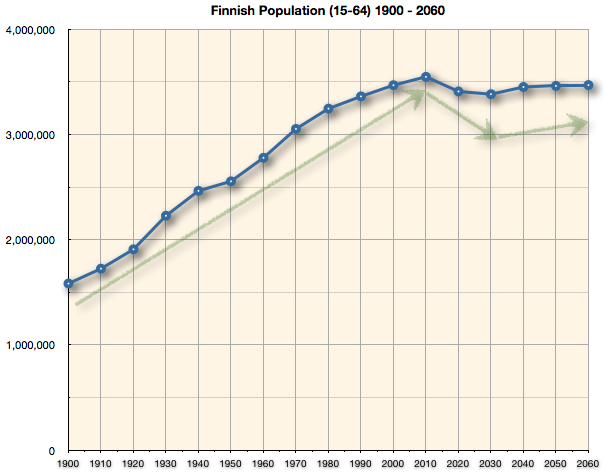
The chart below is really striking. It is the first time in a century that the Finnish population stop growing and in fact start shrinking - re-read that as it defies common senses.

The chart below only focus on the population that can participates in the housing market - this from a generous perspective (I have not seen yet loan given to the 15-20 years old group, but I'm sure it must be in the pipeline - remember vouchers bankers are always turning around and looking for any possible opportunity even if it means selling its soul to the devil in a Dante way)

For me this will have an impact for at least two decade to come. Interesting to see that 2010 is the turning point.

In fact, prices slowly fall for a very long period if the government try to artificially support it (for whatever reasons be it influenced by the industry or for political reasons) and doesn't allow it to reach its fair value where holding real estate will not bear great risk as it is currently the case.


It astonishing to see the structure of the Finnish population in 1900 compare to 2010/20 where the importance of the amount of young and elderly are reversed. The other interesting fact to notice is the period during 1st and 2nd World War where the population kept growing (were they really fighting? :-> peace and love?)

Another interesting and important side of the effect of ageing population is it is an inflationary phenomenon as retired people become net consumers as the following study highlights "The Effect of Aging Populations on Inflation" , here is an extract :

"... those recently entering into retirement (aged 65-74) create great inflationary pressures into the economy as their consumption stream outweighs their earned income potential during that time..."

Conclusion: Not my favorite scenario as I put my faith on the intelligence of this government , regulators and somehow the ECB ... however it could materialize.

Monday, 7 February 2011

Finnish Housing Market


We have all in all 6 clearly defined scenario - that a fact. The question is what will enable one of those scenario, also what are today's elements that could favor one of those.

Let's first describe each of those scenario , secondly set the current political, economical and social context, and finally put some probability on each one, highlighting one. All need to be done in a neutral and analytical manner.

Since lately I have been quite busy - I will complete that on a regular basis. You are free to provide some elements. It will be very fruitfull to have a collaborative approach in this analysis.

Scenario 1:
Scenario 2:
Scenario 3:
Scenario 4:
Scenario 5:

Scenario 6:

Population is ageing very fast which will put the housing market in a completely different direction, at least not behaving as it did since 1980. This could unleash a Japanese type housing scenario. You will find more on the following article: Scenario 6 : Toward a Japanese Style Correction -60%?

Context: Economical

Context: Political

Context: Social


Conclusion:


To help on that here are some important chart to take into account:

Year-on-year changes in index of wage and salary earnings 2000–2010, per cent :


12 Month Euribor charts:


Households' indebtedness

Housing Price inflation adjusted - 2000 as the base (100) :


Finnish housing Loan rate reference:

An interesting point: Trichet, Liikanen are all but leaving this year.

Saturday, 1 January 2011

Happy New Year 2011 !!


Would 2011 be the year that demonstrate that housing is solid as rock or inflated as one of the biggest multi-generation housing bubble?

"Solid as Rock or Rock and Roll?"

My guess is that all the possible ammunition have been fired (low interest rates, government subsidies, municipalities land cartel, no (or incompetent, biased) regulators, economical and monetary subsidies, all subsidies that have been fired around the world...).

So the only one left is the high inflation card which will be disastrous for Europe and the Euro in particular and certainly not in the card of the next president of the ECB (The German austerity oriented Mr Axel "Axe Inflation" Weber).

Nevertheless, I will start as planned the countdown quarter by quarter of the Finnish Housing price.

In the meantime, enjoy the start of a new decade, one that will surely be different to the past one. By the way, not sure what it will mean but my first post for 2011 will be on the date : 01.01.11-01.11.00 (the binary decade)

Thursday, 16 December 2010

ECB Covers while Consumers run naked...

16 December 2010 - ECB increases its capital

The European Central Bank (ECB) has decided to increase its subscribed capital by €5 billion, from €5.76 billion to €10.76 billion, with effect from 29 December 2010...

In order to smooth the transfer of capital to the ECB, the Governing Council decided that the euro area national central banks (NCBs) should pay their additional capital contributions of €3,489,575,000 in three equal annual instalments.

...maybe consumers should follow suit after all... risk management as they said...

Finns Commit 91% in Crime in Finland

See the link

No Comment.

The link is not valid any more ... the news which was spread in all Finnish newspaper was that 9% of crime in Finland were done by foreigner - obviously the news headline suggest to most reader that crime is associated with foreigners (readers are not good with maths)... this is again the power of communication....

Monday, 8 November 2010

BOF

Artificial Rebound

"Domestic demand has also picked up in response to the revival of household consumption demand and housing investment. Exceptionally low interest rates and government action to support housing construction have supported the domestic market through the recession."

For several years, Finnish labour costs rose faster than the average for the euro area. Although the most recent wage settlements have been much more moderate, this will be
insufficient to correct the exaggerations of the ‘crazy years’.

The growing levels of debt have recently been a source of general concern. It is not possible to draw a firm line that would indicate in all situations what is an appropriate level of debt, and what is excessive. In the final analysis, this depends on numerous household specific factors."

"From the perspective of households themselves, the greatest risks relate to not being properly prepared for a potential rise in interest rates, a sudden drop in their income or other unexpected situations that could undermine their ability to service their debts.

With this in mind, it is very important that households conduct their own sufficiently rigorous ‘stress tests’ on themselves when considering taking out a loan.

Households need to be able to service their debts in the event of interest rates becoming considerably higher than they are at present. This is also in the interests of the banks and other lenders.

Finally, it is also important that households leave themselves sufficient room for manoeuvre in case of possible changes in their general income and expenditures."

1- Indeed, Interest rates will go higher...at some point(that is the 712 600 € question), that is the only direction it can go unless the deflation threat has not really disappear since so far there is no obvious signs suggesting otherwise.

Sudden drop of their income, interesting point. This recession could have provided an opportunitty for better Finnish competitiveness or the convergence in term of wages with the rest of Europe ... However thanks to Politicians (not excluding the finance ministry), they thought otherwise - the group of wise wild wisest started to think hard how to fight a natural readjustement and they managed it ...( even contruction workers wages are going higher, above the inflation rates -ast)

2- Mr Erkki Liikanen & Co, somehow worries me and in some extent scare me when he talks of the need of "Stress Test" on Household - isn't that the role of banks in Finland and ultimately the roles of regulators - after all that is their job. Worrying idea, highlighting the fact they have no visibility on how securely they grant loan to household.

3- In the last press conference from the ECB, there was a very interesting suggestion from Mr Jean-Claude Trichet, highlighting that non-conventional monetary operation could happen and outrule an increase of interest rates. So I read it as, if the deflation threat was overdone and the tsunami of liquidity trigger a sudden deadly rise of inflation (mostly imported that could or giver the tentation for translating into higher home inflation), then they will pull the trigger and of course the Finnish market and politicians would not be able to do anything about it. The municipalities debt would also slowly but surely look like the one experienced in California.

Monitoring closely Debt levels

"Moreover, a large debt burden weakens the ability of households – and, indeed, the economy as a whole – to adjust to disturbances of various sorts. In order to ensure stable development of the economy, it is vital to closely monitor debt levels."
When the symptom have already appeared, isn't it already too late? So BOF will become firefighters always a step behind the event....let's closely monitor their inaction and how they will act to prevent the system to break apart when it would have been simpler to request moderation and stability.

At the end we do not have central bankers but alchemists...

Source: BOF , there is more to say, but I will try to extract some other interesting info whenever I can

Friday, 5 November 2010

For Fun : The Kalmar Union (KU versus EU)


"The Kalmar Union (Danish, Norwegian, and Swedish: Kalmarunionen) is a historiographical term meaning a series of personal unions (1397–1523) that united the three kingdoms of Denmark, Norway (with Iceland, Greenland, Faroe Islands, Shetland, and Orkney), and Sweden (including a part of modern day Finland) under a single monarch, though intermittently and with a population less than 3,000,000.[1]

The countries had not technically given up their sovereignty, nor their independence, but in practical terms, they were not autonomous, the common monarch holding the sovereignty and, particularly, leading foreign policy; diverging interests (especially the Swedish nobility's dissatisfaction over the dominant role played by Denmark and Holstein) gave rise to a conflict that would hamper the union in several intervals from the 1430s until the union's breakup in 1523 when Gustav Vasa became king of Sweden."

The establishment of a single currency zone with a unified monetary policy that rules all countries in Europe have shown mixed results. The north, the south, the center and the east have all shown signs of divergence instead of the desired convergence.

So would it be better, instead of having a monolithical system, splitting the control into smaller more manageable entities - The north by re-establishing the Kalmar system , for the South by creating the "Calamares" (...let's not call that PIIGS...) entity , the center by creating the Franco-German Group ...."


Bon Appetit!

Monday, 4 October 2010

Finnish Housing Bubble - AsuntoKupla 2010

“I’m very worried,” Finnish Finance Minister Jyrki Katainen said in an interview. “There could be a housing bubble in the making in Finland. There is a risk that mortgage borrowing costs are too low.”

House prices in the three countries (Norway, Sweden, Finland) rose last year even as their economies contracted and unemployment shot up, creating imbalances that economists say now need to be corrected.

About 95 percent of mortgages in Finland and Norway track money-market levels, while about 60 percent of Swedish loans are based on adjustable rates. That compares with the 90 percent of German homeowners whose interest payments are fixed, meaning last year’s record low borrowing costs fed into the Nordic region faster than elsewhere in Europe.

In Finland, the ECB’s 1 percent benchmark rate may be misaligned to the Nordic economy’s needs.

“For preventing bubbles, it would of course be good if Finland had its own monetary policy,” said Mikko Forss, an economist at Roubini Global Economics in London. “Still, it’s not enough alone, as has been argued also by central banks in Sweden and Norway. Regulation is probably the best tool.”
Source: Bloomberg

The worrying part is the consumer confidence that break all time records while the global economy is fighting for its survival. Who says that media didn't have any power and didn't distort information?

Nethertheless, as you have notices on the right top side, I will start counting the decline of housing price from 1st quarter 2011, since the dynamic will most probably hold until year end.

I don't know why, but I feel if I was back in 1990, I would have been living the same situation- let's wait and see -

Monday, 6 September 2010

Housing Price Monitor - 2011 Historical Turn?

The blog started in Q4 2007 to warn that we were entering in a "turbulent" period from an economical, political and social perspective.

After the year that followed , we saw the stock market halving in value while housing corrected but gained even more momentum.

The housing market benefited indirectly to measure that was aiming at stabilizing the economy- call it a "collateral damage". Around the world, in the past three years, fiscal and monetary stimulus were enacted, reversing or stabilizing a synchronized world wide fall in trade and consumption.

The Finnish housing market is now showing all the characteristics of a very severe housing bubble that mainly inflated due to :

- various government stimulus , designed to support employment in the construction sector
- Finland interest rates are controlled by the ECB that has its monetary policy designed to support Germany, France, and the southern countries (Greece, Spain, Portugal ...) that are at the hedge of defaulting on their unsustainable debt.
- land control -cartel like- from municipalities
- bank model on assessing credit risk and fuelling an unprecedented housing loan growth)
- bank granting only variable rates based mortgage (98% of all mortgage originated) and the fact that the government is still guaranteeing 30 % of those mortgage.

I have added on the right menu, a housing price monitor that I will start to update from the 4th quarter of 2010, since I'm calling a sharp reversal into 2011-12. I will use the 4th quarter as the base from price coming from statistics Finland.

Why do I think that a turn is now settling and probably sure to happen. Here are some arguments:

1- An unsustainable Household debt that has shown that when the growth reverse, the trend carries for many years to come based on the fact we had a biggest run-up in credit growth than even the 90's or 80's.


2- Consumer confidence at all time high. Consumer Sentiment has always suggested a sharp reversal when a peak is reached.


Note: This article will be updated as it is a first draft but I though it was better to share so to update it depending on the comments...