Sunday, 25 September 2011

On the trend of housing price

"It is a fallacy to think that loose monetary policy can solve the large structural problems we are facing. Central banks must not become the victims of their own success and should not become overburdened. Historically, whenever policy makers tried to broaden the role of monetary policy beyond its original role as a guardian of the value of a currency, it had to compromise on its objective of price stability. For monetary policy to remain effective, its responsibilities must remain within clear limits.

Instead, we need a growth model that is different from the one during the years before the financial crisis. We need economic growth that is based on a genuine increase in productivity, and not on low interest rates and the accumulation of debt. The unlimited accumulation of private and public debt before the financial crisis has now become a burden on economic growth and should be reduced progressively. [14] To achieve this we need far-reaching structural reforms that increase competition in labour and goods markets, more financial supervision, and a stronger fiscal policy framework.
", Jurgen Stark, 24 Sept. 2011

I always liked Mr Stark, too bad he resign from the ECB executive Board.

One important thing, He is highlighting is that the crisis as show that private or public accumulation of debt as witnessed in the past 20 years is not sustainable.

It interesting, in fact, to see that the the crisis that started in 2007-2008 marked a turning point in the economical model we were accustomed. In particular, it is at that point I thought that the housing price rise driven by massive credit growth was put in question. Of course, it takes time before the trend reverse, you are dealing with "agents" that shift their behavior with a drastic lag.

Most people would not consider that price of housing will be lower than it is today in the year to come- it is not what they have been conditioned to.

Bankers still want to ride on easy-to-take profits at the expense of people, promoting all but a stable economy.

Real Estate are also accustomed to easy commission, easy sales and would not think that their industry would start to shrink in the year to come with plummeting commission and higher competition.

Wednesday, 14 September 2011

Greece About To Default


1 year government bond shot up to 140% !!, Finland has better hurry to get its collateral in place otherwise it's gonna be collateral damage.

Will Greece default this week end in the next few weeks?

Friday, 9 September 2011

9/11 - Nine eleven - We are all Greek - ...and also Italian...


On Sept 2011, nine eleven - to echo clearly what is going on, let's put few facts on the table:
  1. interest rates on 1 year government greek bond shoot to 98%, which means that if you invest in those bonds you double your money each year. Obviously, you won't do that. The market is saying that Greek is about to default on its debt.
  2. Mr Juergen Stark resigned this 9.11, following few months early the departure of Mr Axel Weber, high figures of the ECB executive board. That says a lot on the fragmentation of opinion or strategy on the direction of the ECB monetary policies. On other words, The germans totally rejects the bond buying purchasing program or the bail out initiatives launched on the Greek and Italians debts.


Disintegration or no disintegration of the euro area, that is the question on the item highlighted above. Would a break occur and if so what are the consequences? This will shape the future of the economical and political landscape in the generations to come.

Break of the euro zone is what the market is pricing and it is what the ECB has been fighting all along during this crisis. Would Greece exit the euro zone and get back to their drachma in order to regain lost competitiveness or would German exit in order to safeguard Germans against inflation, returning to their old currency the "Deutsche Mark" in order to let it appreciate?

What would be the consequence of such event on Finland - especially on the housing market?
My answer would be to paraphrase Joe Granville from his 1960 book, "If it's obvious to everyone, it's obviously wrong." As a contrarian, I feel that everybody sees housing price going higher and never retreating, I see people investing in housing and seeing it as a 100% safe investment and I see irrational exuberance around an asset that does not produce anything...then this worries me.

On the monetary front, It seems now that the ECB policy has aggravated, rather than ameliorated our basic problems because it has encouraged an unwise and debilitating buildup of debt, while also pursuing short term policies that have increased inflation, weakened economic growth, that will ultimately decreased our standard of living. As a consequence, People are defecting the ECB, and encouraging unilateral initiative as expressed by Finland in its pursue of collaterals in the Greek bailout. All in all, the mess get bigger and bigger and history is no guide as what is happening is unique.

Thursday, 8 September 2011

Hypo...potam?

"Finland's Mortgage Society (Hypo) warned Thursday that the country's housing market was losing steam quickly, with prices having peaked in June.

The lender added that consumer confidence was set to revisit the late-2008 low this autumn.

Hypo said the drawn-out sovereign debt crisis was raising the spectre of a credit recession.
"
source : STT

I will be interesting to see if Hypo past track records were in line with reality....

Wednesday, 31 August 2011

Housing and Demography


"At the end of 2010, the number of families with children totalled 582,000... the lowest figure ever recorded in the statistics, with a decline of 1,800 from the year before...

Twenty years ago in 1990, the total number of families with children was still 640,637, and approximately one half of the population were part of a family with children
."


Source: Statistics Finland

The number of families is at historically low and lower than it was in 1990 - really astonishing!

A similar discussion on this subject had already occurred in the blog, refer to "Population Perspective"

Indeed, Finland is facing with very serious issues. family formation is on the decrease and is getting older. In the meantime, housing building permit had an exponential growth in the past two decades and price tripled. A real conundrum for assessing where the finnish economy is heading and particularly how the housing market will behave in the next two decades.

Monday, 22 August 2011

"The Thin" Capability, Maturity Integration ....

"Moody’s criticises Finland’s demands for Greek guarantees


US credit rating agency Moody’s told on Monday that the bilateral guarantee agreement between Finland and Greece could lower the Greek credit rating, and the credit ratings of other struggling eurozone countries.

The Finnish guarantee demands could also delay the second Greek bailout package and so lead to failure to pay, Moody’s added.

The agency expects the euro countries to reject the agreement between Finland and Greece."


I am actually shocked by the initiative launched by the finance minstry regarding the Greek guaranty. Not only it has been a showcase, where Finland lacked complete understanding and maturity on the Political european stage, but also endanger a fragile cohesion that is currently being tested within all the european countries.

I suppose it was driven by vanity and for domestic political gain- maybe even to reduce the popularity and the electorate size of the "the thin" party.

Sunday, 7 August 2011

Deflation Forces, back Again in Finland.

Link
The chart above - the 2 years Finnish government bonds - shows that the yield (interest) has literally collapsed since July as if investors are panicking, ready to get almost no return or even paying for it (less than 1% when inflation is running at 4%) on those bond investment in return to investment safety. Sure they must be betting for deflation, they clearly foresee no inflation or worse deflation.

To me it looks like investors hint a recession in Europe - a deflationnary force that would be inline with the bond reading. In this context, It would be strange to see real estate price going up, or at least a last shoot up and a collapse. Actually, here is my forecast, from this point:

The bizarre situation is that in Germany, Finland, interest rates on 2 years are falling while in France, Italy, Spain and Portugal, yields are soaring. What can the ECB do? nothing really .

I am wondering how Finnish Pension Fund (Ilmarinen, Varma, etc...) will be able to cope in such environment, which would mean higher unemployment, low interest rates , lower stock price and rising retiree departure (which means income need to be provided, a promise made during the worker lifetime). Of course, this is based on the catastrophic scenario of Europe going back to recession.

Above is the chart of the 10 years Finnish Government Bond and a possible project on where yield could go. To me this chart is important, as it could show that the rebound in yield we say in the past two years (similar can be said to the economy
) was powder in the eyes, only supported by more debt and an artificially inducted confidence.

So should yield fall to the level of March 2009 or go lower than, we are a depression territory. Obviously this are only conjecture from a long time bear (since 2007), my negative view on debt binge and artificially supported economy has not changed, and more they fail to recognize the size of the problem , the bigger will be the fall and the negativity it will bring to the society as a whole (I'm still thinking of post 1929, and its far reached consequences - I'm just hoping they have learned their mistakes)

Friday, 5 August 2011

Finnish Housing Price - The Party is over?


Considering what is currently happening to the European Monetary vision, considering that Finnish Household indebtedness is showing worrying features, considering that housing price had double nationally since the beginning of the decade, (and even triple or quadruple locally). I think WE ARE ABOUT to witness an historic downturn for the housing and economy in Finland and in Europe as a whole - (and still holding my breath) - The party is about to end.

So far people have been spending, logically in sync with housing price rising, in a phenomenon called the wealth effect. People, sometime forget that housing price are cyclical, and are bound to go down after going up. So how the household will react when his wealth start shrinking, would he continue to take more debt, to spend more? The answer is simply no, based on what is currently happening in the US (high leverage household with falling house price, starting saving quite heavily).

Wednesday, 3 August 2011

Finnish Construction Sector - A Market View

A picture is worth a thousand words as the old banker wise once said. Above is the construction and engineering sector in Finland. Apparently the market is seeing a sharp slow down, something similar to the summer 2007 where a year after the housing market made a tentative readjustment.

Talking about the readjustment that did not happen in 2008, there are many reasons for that.

1- Interest rates tumble, literally fell in a free fall - helping interest rates sensitive mortgages, which represent above 90% of Finnish mortgages. To that, add also the record length of mortgages provided by bankers.

2-The current crisis (which we have yet to see the end) was a threat to the banks and the financial system as a whole. During that period, real estate was seen as a safeguard - at least money had to be parked somewhere perceived solid. The same was witnessed for Gold, Silver etc...

3-A relative game, North europe is seen as safer than the south in all possible dimensions, hence investment is rolling, fueling , even greater household leverage, that have been pilling up debts, as never witnessed before. to that extend, Banks had never stopped lending...


Nevertheless, the market is saying that the housing sector or construction sector is about to experience "something" not so good. A simple readjustment or an "Iconic Nokia" type readjustment that could bring price toward their 1996 prices. Time will tell.

Wednesday, 22 June 2011

Post Traumatic Stress

"In Finland, the rising trend in house prices has flattened out since spring 2010.

The moderate rise in market interest rates has helped restore a more balanced position on the housing market.
Even so, the relative price of housing is still higher than the average for the past decade.

From the perspective of macro-stability,
the trend of recent years in household debt has displayed worrying features.
The proportion of highly indebted households grew rapidly throughout the first post-millennium decade.

Continued growth in household debt will undermine the ability of both households and the economy to adapt to economic disturbances.
"

Source: http://www.suomenpankki.fi/en/julkaisut/bulletin/financial_stability/Documents/B_2_11.pdf

To that statement, I see a worrying Bank of Finland that is relief that housing price somehow take a pause in 2010 however Bank of Finland seem to show all the element of a post traumatic type stress due to the unprecedented rise of debt level, when compared with what makes sense to compare to, the trend in debt over time.

I highlight the fact that recently bankers and politicians like to play the relative game by measuring data with other international data - i.e our debt is lower then the neighbor debt while failing to see and address the internal issues at the time when all warning are red.

That was my morning thought...I go back hibernating.

Monday, 18 April 2011

Finnish Politics, From Another Angle ...

So Finns usually quite in the international scenery, have spoken - out loud -

So here are the results in 3 statements:

* 80% of people did not vote for National Coalition Party - hence a party that represents only 20% of the total share of voters - yet there is plan to raise extract from it a prime minister.

* 700% more MPs for True Finns - for the anecdote, each time I have talked to finns (true or not, how do you recognize a true finn - A Nokia mobile owner? oops I have a great iPhone)..so I talked to (88.2% true) finns around me they always find good thing in this party - maybe PS program is not clear, so whether they represent or not evil, we will see. This blog will alert you if it is the case ;-), and time to pack to the "bad" countries: to Greece "dream" Island, "Margarita" Spain, or "nice curve" Portugal - I hope it won't happen I have got used to -20 degrees for 6 month of the year (As Darwin theory predicted, I have evolved rapidly, my skin adapted and looks to have mutated to a bear type - cold proof- appearance showing a new layer of "true finns?"cells)

*Collapse of the Center Party - wondering if in the last election they did well due to the help of a corrupt behavior.

Result: Not sure if this will end up in a government ungovernable - something like the titanic hitting the Soini-Iceberg.


Sunday, 20 February 2011

Scenario 6 : Toward a Japanese Style Correction -60%?

This article presents one the 6 scenario that has been put in the following article : Finnish Housing Market

Scenario 6 is the most bearish of all, it was a possibility during the peak of the financial crisis in the end of 2008. However, central bankers around the world were prepared and had clear plans on how to treat the severity of the crisis - cutting rates to virtually zero, purchasing states/government debt however I'm not if they how it would unfold and how manageable it will be.

All in all, during that period, private debt was shifted toward public institutions, and tax payer's money was used as an air bag to contain a rapid and violent shock. Finally all Banks were rescued or so were given the promise. The market recovered and credit flowed as nothing had happened - at least on the surface.

So scenario 6 was avoided, a scenario that would have seen housing price falling by 60 % in a matter of a year or two, something similar as in the 1990's Finnish Housing Bubble.

Could scenario 6 be totally avoided? Should it be removed from the probable scenario? Not so sure. The difference will be its duration, this time it could take 3 decades before house price fall by 60% - a scenario that is currently unfolding in Japan housing market.

Let's look at the Japan housing price to refresh memories or for some to discover it , something that could be at first a surprise or a shock - after all people have been conditioned that real state never falls and it is still well anchored in all mindset:


So what could push Finnish housing price into the Japanese type scenario and see its value slashed by 60%?

Remember also that land is a limited resource in Japan, after it's an island, but the most striking similarity would be an ageing population.

Interestingly enough, Statistics Finland kindly has provided a projection of the population for the next 50 years - one could argue that accuracy, on that projection ,would be higher for the next two decades... Good, because this is what interest us.

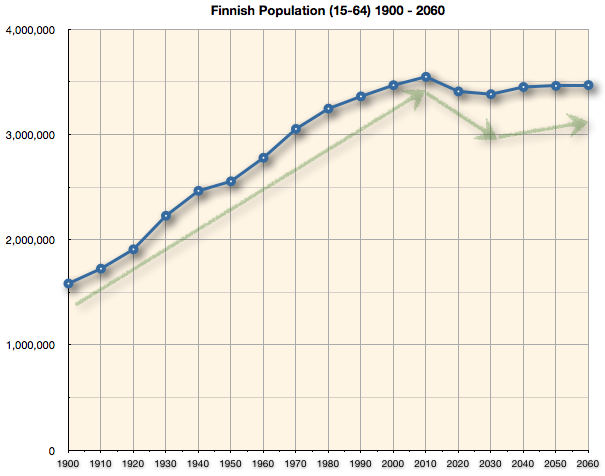
The chart below is really striking. It is the first time in a century that the Finnish population stop growing and in fact start shrinking - re-read that as it defies common senses.

The chart below only focus on the population that can participates in the housing market - this from a generous perspective (I have not seen yet loan given to the 15-20 years old group, but I'm sure it must be in the pipeline - remember vouchers bankers are always turning around and looking for any possible opportunity even if it means selling its soul to the devil in a Dante way)

For me this will have an impact for at least two decade to come. Interesting to see that 2010 is the turning point.

In fact, prices slowly fall for a very long period if the government try to artificially support it (for whatever reasons be it influenced by the industry or for political reasons) and doesn't allow it to reach its fair value where holding real estate will not bear great risk as it is currently the case.


It astonishing to see the structure of the Finnish population in 1900 compare to 2010/20 where the importance of the amount of young and elderly are reversed. The other interesting fact to notice is the period during 1st and 2nd World War where the population kept growing (were they really fighting? :-> peace and love?)

Another interesting and important side of the effect of ageing population is it is an inflationary phenomenon as retired people become net consumers as the following study highlights "The Effect of Aging Populations on Inflation" , here is an extract :

"... those recently entering into retirement (aged 65-74) create great inflationary pressures into the economy as their consumption stream outweighs their earned income potential during that time..."

Conclusion: Not my favorite scenario as I put my faith on the intelligence of this government , regulators and somehow the ECB ... however it could materialize.

Monday, 7 February 2011

Finnish Housing Market


We have all in all 6 clearly defined scenario - that a fact. The question is what will enable one of those scenario, also what are today's elements that could favor one of those.

Let's first describe each of those scenario , secondly set the current political, economical and social context, and finally put some probability on each one, highlighting one. All need to be done in a neutral and analytical manner.

Since lately I have been quite busy - I will complete that on a regular basis. You are free to provide some elements. It will be very fruitfull to have a collaborative approach in this analysis.

Scenario 1:
Scenario 2:
Scenario 3:
Scenario 4:
Scenario 5:

Scenario 6:

Population is ageing very fast which will put the housing market in a completely different direction, at least not behaving as it did since 1980. This could unleash a Japanese type housing scenario. You will find more on the following article: Scenario 6 : Toward a Japanese Style Correction -60%?

Context: Economical

Context: Political

Context: Social


Conclusion:


To help on that here are some important chart to take into account:

Year-on-year changes in index of wage and salary earnings 2000–2010, per cent :


12 Month Euribor charts:


Households' indebtedness

Housing Price inflation adjusted - 2000 as the base (100) :


Finnish housing Loan rate reference:

An interesting point: Trichet, Liikanen are all but leaving this year.

Saturday, 1 January 2011

Happy New Year 2011 !!


Would 2011 be the year that demonstrate that housing is solid as rock or inflated as one of the biggest multi-generation housing bubble?

"Solid as Rock or Rock and Roll?"

My guess is that all the possible ammunition have been fired (low interest rates, government subsidies, municipalities land cartel, no (or incompetent, biased) regulators, economical and monetary subsidies, all subsidies that have been fired around the world...).

So the only one left is the high inflation card which will be disastrous for Europe and the Euro in particular and certainly not in the card of the next president of the ECB (The German austerity oriented Mr Axel "Axe Inflation" Weber).

Nevertheless, I will start as planned the countdown quarter by quarter of the Finnish Housing price.

In the meantime, enjoy the start of a new decade, one that will surely be different to the past one. By the way, not sure what it will mean but my first post for 2011 will be on the date : 01.01.11-01.11.00 (the binary decade)